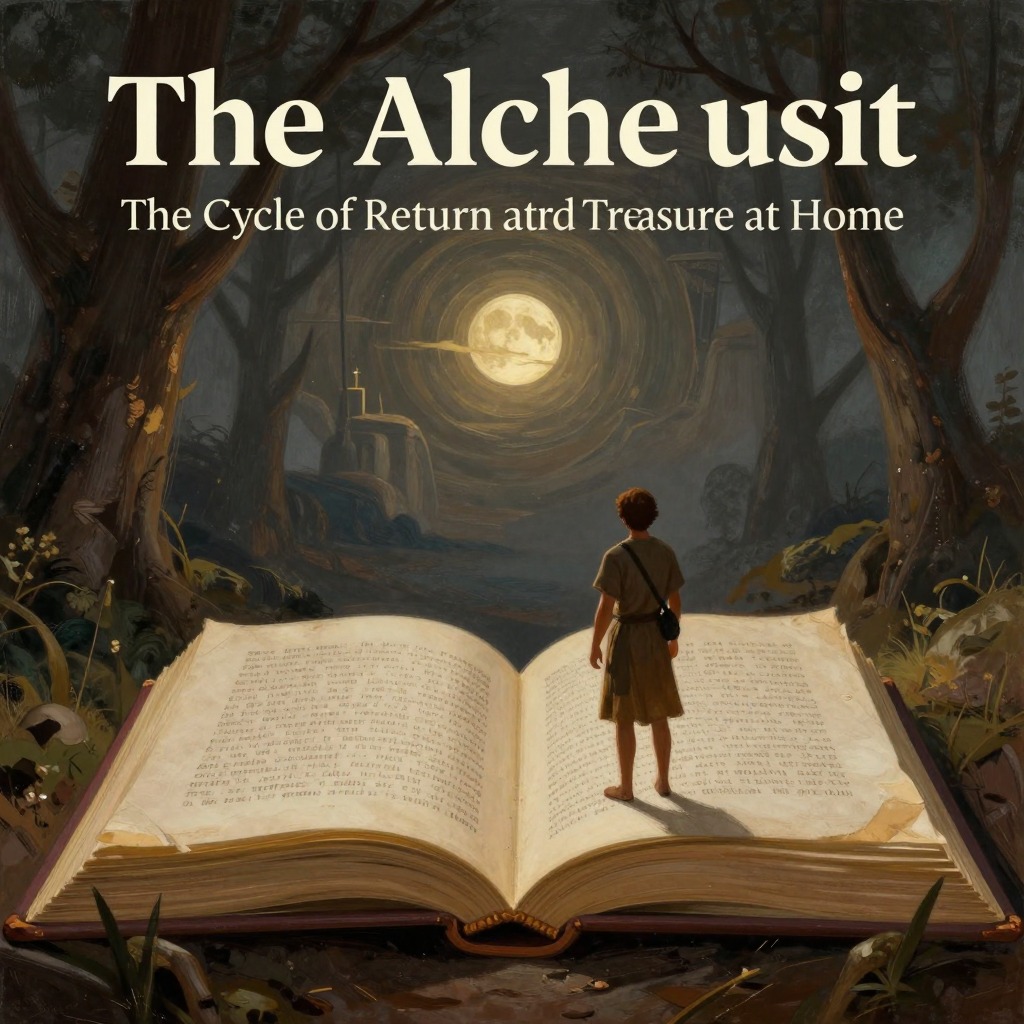
Santiago's recurrent dream of treasure
Santiago's recurrent dream of treasure is the initiating event of the entire narrative, a prophetic vision that first appears in an abandoned church and drives the shepherd to abandon his familiar life, cross the Mediterranean, and traverse the Sahara Desert in search of a hidden fortune near the Pyramids of Egypt. The dream, which repeats twice within a week, sets in motion a chain of encounters—with a Gypsy dream interpreter, the mysterious King of Salem, a thief in Tangier, a crystal merchant, an Englishman, an alchemist, and the love of his life, Fatima—and ultimately leads him back to the very spot where the dream began, revealing that the treasure was buried at home all along.
Content and Circumstances of the Dream
The dream occurs while Santiago sleeps in the ruined sacristy of an abandoned church, where a massive sycamore tree grows through the collapsed roof. He dreams that he is in a field with his sheep when a child appears and begins to play with the animals. Unlike adults, the child does not frighten the sheep, and after playing for some time, the child takes Santiago by both hands and transports him to the Egyptian Pyramids. There, the child says, "If you come here, you will find a hidden treasure." Just as the child is about to show him the exact location, Santiago wakes up. He has this identical dream twice, both times awakening before the location is revealed.
Interpretation and Initial Response
Seeking an interpretation, Santiago visits an old woman in Tarifa who reads dreams. She tells him that dreams are "the language of God" and interprets his vision as a command to go to the Pyramids in Egypt, where he will find a treasure that will make him a rich man. She demands one-tenth of the treasure as payment. Santiago is initially disappointed and irritated, feeling he wasted his time, and decides never to believe in dreams again. However, his encounter with Melchizedek, the King of Salem, who appears in the town plaza and reveals knowledge of Santiago's past, rekindles his belief. Melchizedek explains that the dream is a sign of Santiago's "Personal Legend"—his destiny—and that "when you want something, all the universe conspires in helping you to achieve it." The king convinces Santiago to sell his flock of sheep and use the proceeds to travel to Africa.
The Dream as a Guiding Force Throughout the Journey
The dream remains a constant, though sometimes painful, reference point throughout Santiago's journey. After being robbed in Tangier, he feels ashamed and laments that God would repay those who believe in their dreams in such a way. While working for the crystal merchant, the treasure becomes "nothing but a painful memory" that he tries to avoid thinking about. Yet the dream also provides motivation: when he considers returning to his sheep, he remembers the old king's words and the promise of the treasure. The alchemist later explains that before a dream is realized, the Soul of the World tests everything learned along the way, and that "every search begins with beginner's luck. And every search ends with the victor's being severely tested."
The Dream's Fulfillment and Final Revelation
After reaching the Pyramids and digging where his tears fall, Santiago is attacked by refugees from the tribal wars who beat him and steal his gold. As they leave, their leader reveals that he, too, had a recurrent dream two years earlier—a dream that told him to travel to Spain, find a ruined church where shepherds sleep, and dig at the roots of a sycamore tree growing in the sacristy to find a hidden treasure. The leader dismisses his own dream as foolish, saying he is "not so stupid as to cross an entire desert just because of a recurrent dream." Santiago realizes with joy that the treasure was never in Egypt; it was buried beneath the sycamore in the abandoned church where he first had the dream. He returns to Spain, digs at the base of the tree, and finds a chest of Spanish gold coins, precious stones, and artifacts—the spoils of a forgotten conquest. The dream thus completes a full circle: the call to adventure and the ultimate boon are one and the same place, and the journey itself, not the destination, was the true treasure.